
Greylag Goose
Family: Anatidae (Ducks & Geese)
English Name: Greylag Goose
Scientific Name: Anser anser rubrirostris
Arabic Name: إوَزَّةٌ رَبْداءُ شَرْقِيَّةٌ
Status in Kuwait: rare winter visitor
Eastern Greylag Goose Anser anser rubrirostris
The Eastern Greylag Goose (Anser anser rubrirostris) is one of two recognised subspecies of the Greylag Goose, distinguished from the nominate western form (A. a. anser) by its paler, more uniform grey-brown plumage, larger overall size, and a pink rather than orange bill. Like all Greylag Geese, it is a heavily built bird with a thick neck, pink legs and feet, and pale fringing on the upperparts that gives a faintly barred appearance; in flight, a pale grey forewing panel is a useful field mark. The Greylag Goose is also the wild ancestor of most domestic goose breeds, having been domesticated in the Middle East and Egypt for several thousand years.
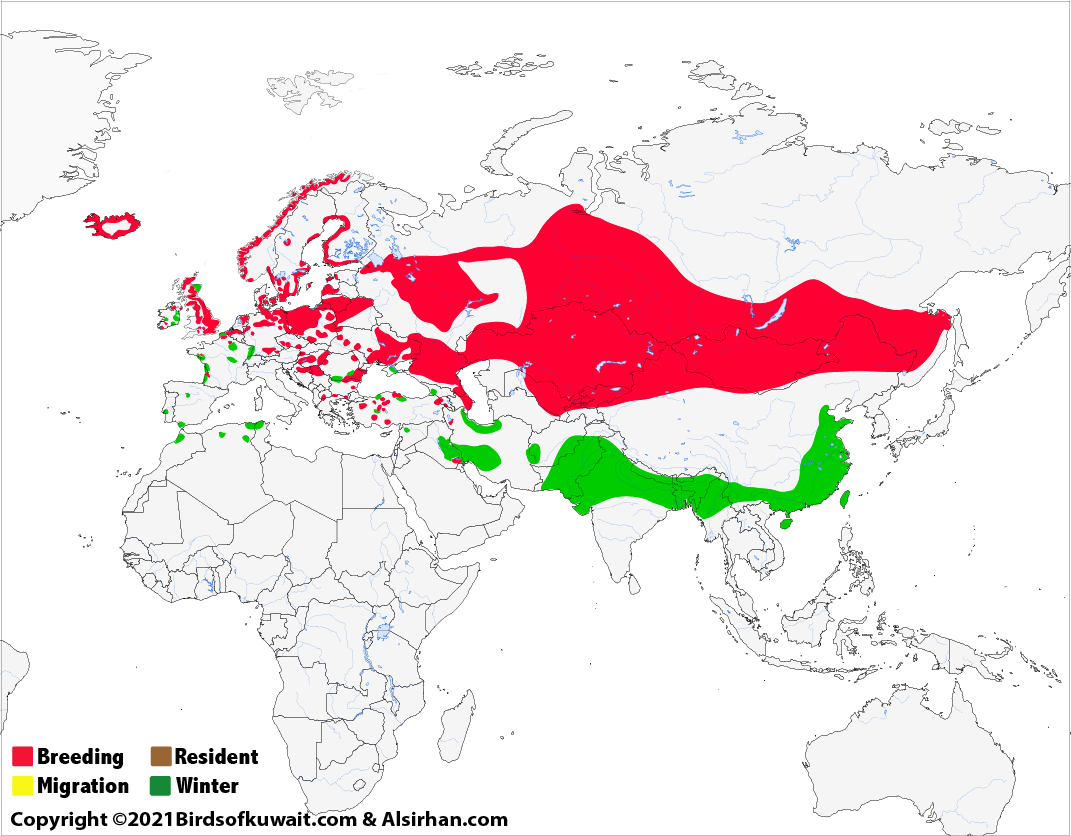
According to Birds of the World (Cornell Lab of Ornithology), the eastern subspecies breeds from Romania and Turkey eastwards through Russia to northeastern China, wintering mainly from Asia Minor eastwards across southern Asia. Outside the breeding season it is highly gregarious, gathering in large flocks that graze on grasses, cereals, roots, and stubble, and it maintains strong, long-term pair bonds even within these mixed winter flocks. Nesting takes place on the ground near water, often on islands or within reedbeds, with clutches typically of four to six eggs.
Globally, the Greylag Goose is listed as Least Concern on the IUCN Red List, reflecting its extremely large range and a large, apparently increasing population estimated at over a million birds. Across the Middle East, wintering birds favour wetlands, lakes, reservoirs, and flooded farmland, with regular occurrences in Iraq and Iran. In Kuwait, it is a rare winter visitor, usually occurring singly or in small groups from November to March at freshwater wetlands and occasionally coastal mudflats; Jahra Pools Reserve is a regular locality for records. It is also an uncommon winter visitor to Oman.
Typical habitats include shallow freshwater lakes, marshes, reed-fringed wetlands, river floodplains, and wet grasslands; outside the breeding season it also feeds in agricultural fields, pastures, and stubble.
Despite its favourable global status, regional populations remain vulnerable to wetland loss and degradation, pollution, disturbance, and hunting pressure along migratory flyways. In Kuwait, shooting is considered a particular threat to geese and other waterfowl.